Samstag, 19. September 2015

Central Pillar of Freney

Time passes fast in Chamonix and my departure was getting closer and closer. I had climbed some nice routes during the last month but I still wanted to do at least one long and committing climb. Isra and I had already talked about a route we both would have liked to climb: the Central pillar of Freney. 


Starter


The last week of August, my last week in Chamonix, finally seemed to offer some really good weather and I was very motivated to take the opportunity to climb as much as possible.
On Tuesday it was still a bit cold and so I joined Isra and his girlfriend to climb a nice and quite easy route on the Montes Rouges (Curaçao, 180m, 6b - 25.08.2015). 


On Wednesday Isra and I took the cablecar to the Aiguille du Midi and climbed the Super Dupont (220m 7b - 26.08.2015) on the southface of the Aiguille du Midi. We abseiled down the face and started climbing in the scorching heat. The route seemed super hard to me. Already the first 6b+ pitch was incredibly hard and slippery due to the sun.


super hard 6b+


One of the last pitches, the 6c, A0 (7b) pitch seemed unbelievably hard to me....I managed to free-climb the short A0 section but as I got o the crack (apparently 6c) I gave up and started to aid climb... Compared to other Piola routes I would have given it 7b!
Nonetheless it was a very good climbing day, even though it turned out to be a little bit harder then expected and therefore we were not exactly as fast as we thought we would be. 

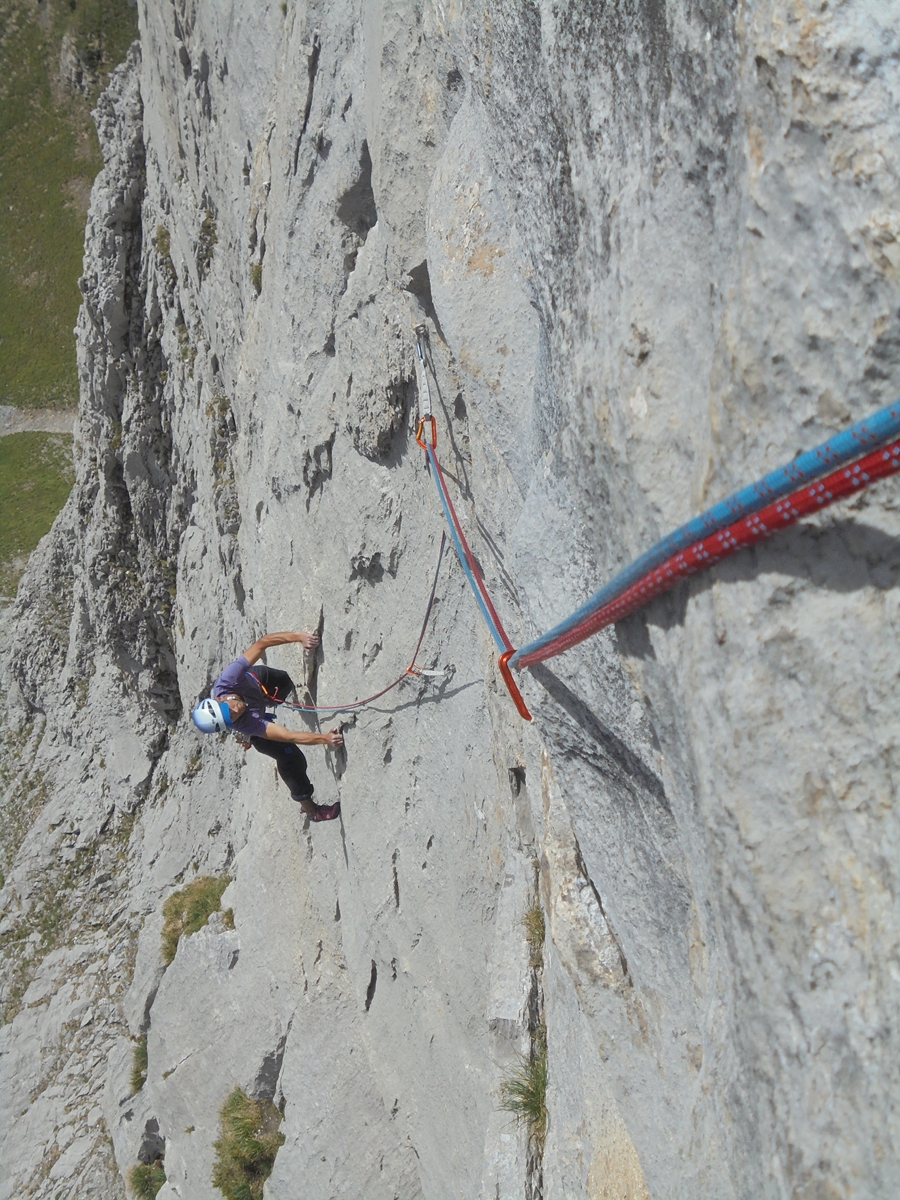
On Thursday I went to do a bit easier climb on the Croix de Fer (Ni dieu, ni maître, 250m, 6c - 27.08.2015) together with Jorge Valle. After a one hour drive and a 1.5 hours walk  we were at the top of the southface of the Croix du Fer. Like on the Aiguille du Midi we abseiled from the top to get to the start of the route. To be honest I didn't expect the rock to be that good. It really is one of the best and more compact limestone faces I have climbed on. The climbing and the grading should not be underestimated...for a rest day route it wasn't easy at all - very technical and quite obligatory sections. 


crux pitch - not easy for 6c


Main course - Central pillar of Freney (500m, 7a+) - 29.08.2015


After getting back from the Croix de Fer I had not only to pack the backpack for the Central Pillar of Freney but also all the rest of my stuff - to pack and organize stuff under time pressure is always a challenge -  it's like playing Tetris :-).
Isra, Silvia and I had dinner together - fortunately Silvia cooked for us, otherwise it would have gotten even later - It was already about midnight when I went back to my tent to sleep, this time without the more comfortable boulder pads as mattress- I had already packed them into my car.
At 4 o'clock in the morning we started from the camping and headed to Val Veny where we left the car at the parking of the Monzino hut.
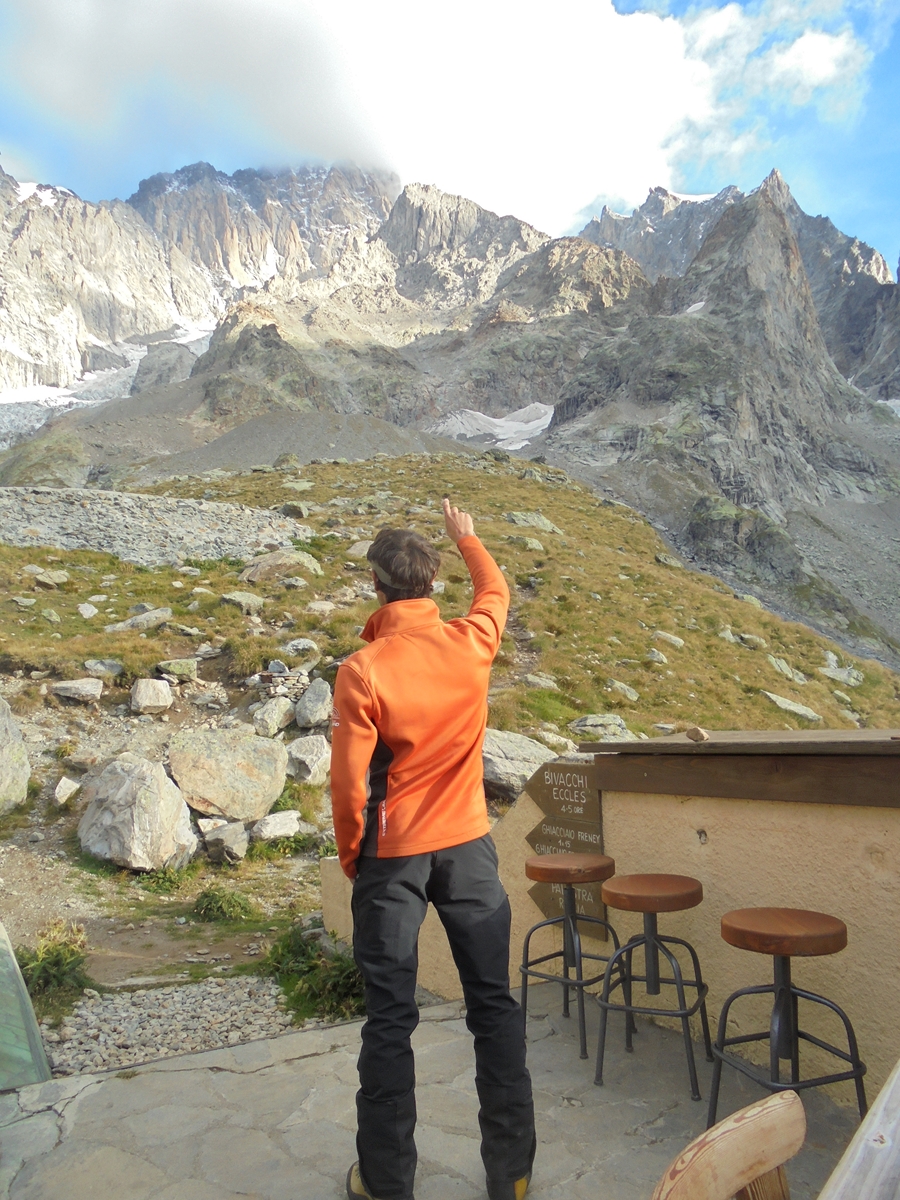
To get to the Eccles bivouac you first have to pass the Monzino hut, already a nice two hours walk, about 1000 meters. We stopped there for a coffee break and then moved on because we still had a looong way to go.  The approach to get to the Eccles bivouac is probably the longest approach I have ever done in my life: 2300 meters from the parking. It is recommendable to start very early from the parking in order to get to the glacier before the snow gets to soft unless you don't like to make some extra effort ;-) (obviously less complicated in spring)
The Eccles bivouac (in fact there are two bivouacs - one shelter with nine places and another one a bit higher with 6 places) is mainly used by climbers who want to climb the Innominata ridge and therefore it is also recommendable to get there quite early in order to find some place.   
The conditions on the glacier weren't perfect and so we had to wend our way up through the crevasses. At half past one we were at the bivouac, so we had plenty of time to melt water, eat, dry our clothes and shoes and rest a little bit. After a while some other alpinists got to the bivouac and finally we were six people sleeping in the lower bivouac and four sleeping in the upper one. 


We got up at about half past three and started from the bivouac at 4.20. Some climbers had told us that the direct access to the Col d'Eccles wasn't in good conditions and that therefore it was better to climb the Pic d'Eccles and then abseil down to the Col. As we were the last ones to start we lost some time waiting and so we got to the Col at the first light. The conditions to get to the base of the rock face weren't good at all. According to the Batoux-guidebook the approach time is two hours. In springtime, or when all the loose rocks and the ice-slopes are covered with compact snow it possibly won't take you more but as the conditions were not perfect it took us almost four hours to get to the start of the route. From the Col we first had to do two 25 meters rappels (on the rocks a bit to the left of the couloir that descends from the Col towards the Freney glacier). Then we traversed about fifty meters to the left on quite easy terrain and then we did two fifty meter rappels (one abalakov) to get to the bottom of the ice-slope. To us it seemed the safest way because otherwise we would have had to do a quite long 50 degrees traverse on hard ice.


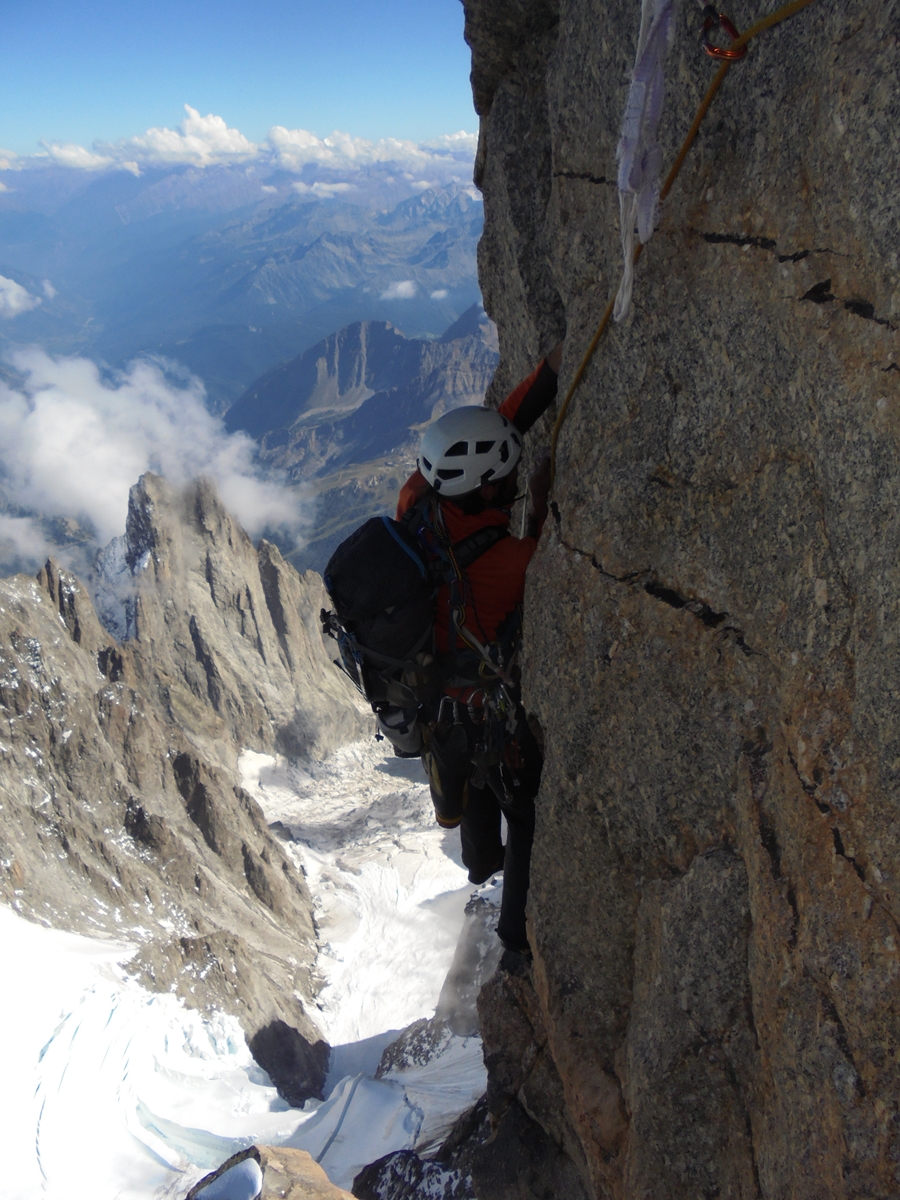
The route starts at about 4000 meters. The first pitches were quite easy and thanks to the warm sun it was very comfortable to climb (except for some sections with a bit of ice and a few meters of full-shower on the last 5c pitch. About 12-14 pitches lead up to the foot of the steep rock pillar called " la Chandelle", where the main difficulties start. As we climbed with our backpacks on, until the last four pitches underneath the Chandelle I preferred to climb in my alpine boots. At about half past two we were at the base of the Chandelle. The sun had turned the corner and a gentle breeze was blowing - it got freezing cold. I took the opportunity to do a short striptease to put my long underpants on. 


The first pitch of the Chandelle is a nice 5c crack. The following pitches are the hardest ones: a 7a pitch where you first have to climb up for about 20 meters and then traverse to the right for about 20-25 meters. If you want to free climb the pitch you better stop after the first few meters of the traverse. There is a good belay and if you would climb on probably you would run out of gear unless you have 20 quick draws. Anyway you would have to deal with some rope drag. I am not really sure if the topo in the guidebook is correct, as it really seems way more logical to me to do two pitches.
Even though it was really cold and I don't like to climb with cold fingers at all, I wanted to try to free-climb as much as possible. I was almost a bit surprised but also very motivated as I managed to on-sight the first traverse pitch (until the first anchor -  hard sequence before the anchor). After Isra had got to the belay I started to climb the second traverse pitch. My fingers and my toes got colder and colder and there was no way to warm them up. It felt a bit like climbing with claws and the more further I got the less I knew how much further I could go. Finally about 2-3 meters before the next anchor I had to grab the last two slings that were hanging from the pitons - probably it would have been possible for me to climb it if it would have been a "bit" warmer, but in that situation it was the only thing I could do. The freezing cold didn't leave any space for disappointment. I just wanted to get out of these pitches and put off my climbing shoes. While Isra seconded the pitch I started to swing my legs and arms to regain some sensibility. Endless minutes hanging in my harness - a feeling I will never forget. Isra started to climb the next pitch, the famous chimney-pitch: first you climb up a crack with a small overhang for about 15-20 meters and then you have to squeeze yourself up the chimney. Still swinging and clapping hands and feet I belayed Isra . Than it was my turn. I managed to free-climb the crack until I got to the chimney. I tried to climb as fast as possible, screaming like a bear as I couldn't feel my fingers anymore. In the chimney I grabbed everything there was in order to get to the belay as soon as possible. If you wanted to free climb this pitch it would be essential to get there with sun and haul up your backpack! 
at the base of the Chandelle

5c-crack

start of the first hard pitch

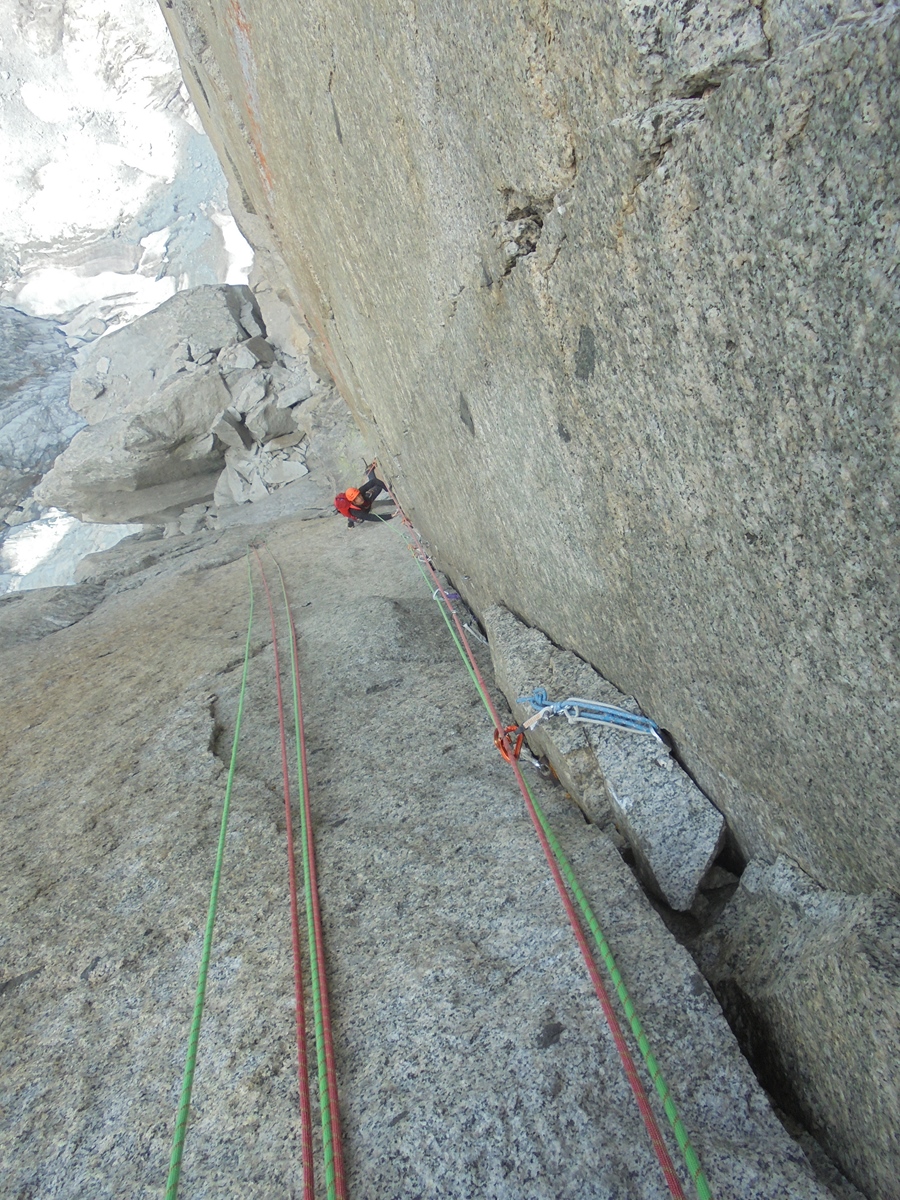
7a - pitch


second 7a pitch if you split up the pitch


7a+ pitch


the chimney

After these hard pitches we had to climb another four pitches to get to the top of the Chandelle. A nice cool down compared to the hard pitches :-).
We got to the top of the Chandelle at about six o'clock. It was a big relieve to put on the hard boots and and slip into the down jacket.
From the Chandelle we had to do one 20 meters rappel and then we quickly climbed up to the summit ridge. From there we walked over to the Mt. Blanc de Courmayeur and to the Mt. Blanc. We reached the summit at 20.20, sixteen hours after we had left the Eccles bivouac.
We decided to descend the normal route via the Gouter refuge. We did a short stop at the Vallot bivouac and then went down to the Gouter where we cooked something and then we kept on descending to the Tète Rousse refuge. We slept there for some hours and then descended to the Nid d'Aigle where we took the train and then the cablecar to descend to les Houches.


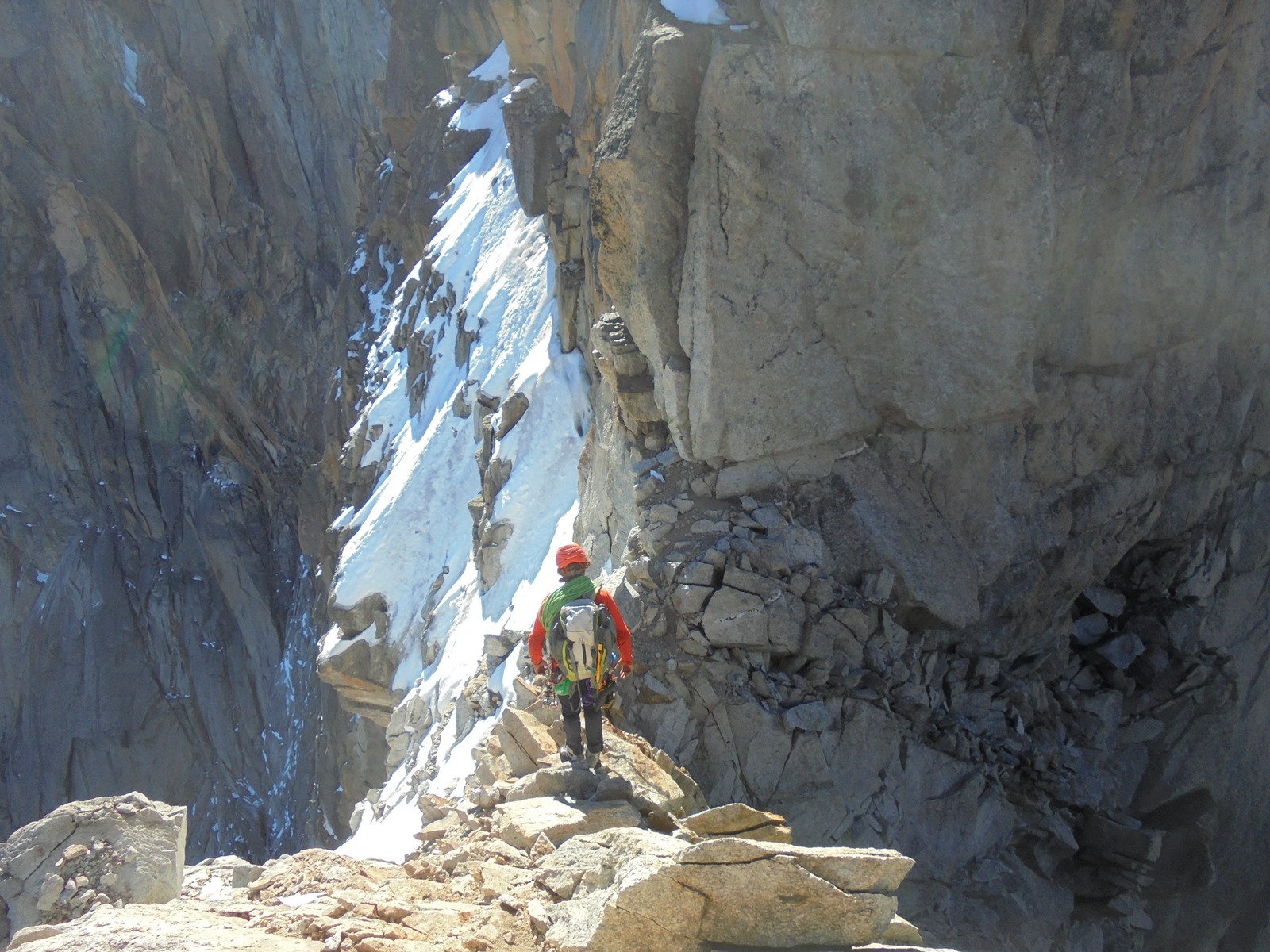
top of the Chandelle


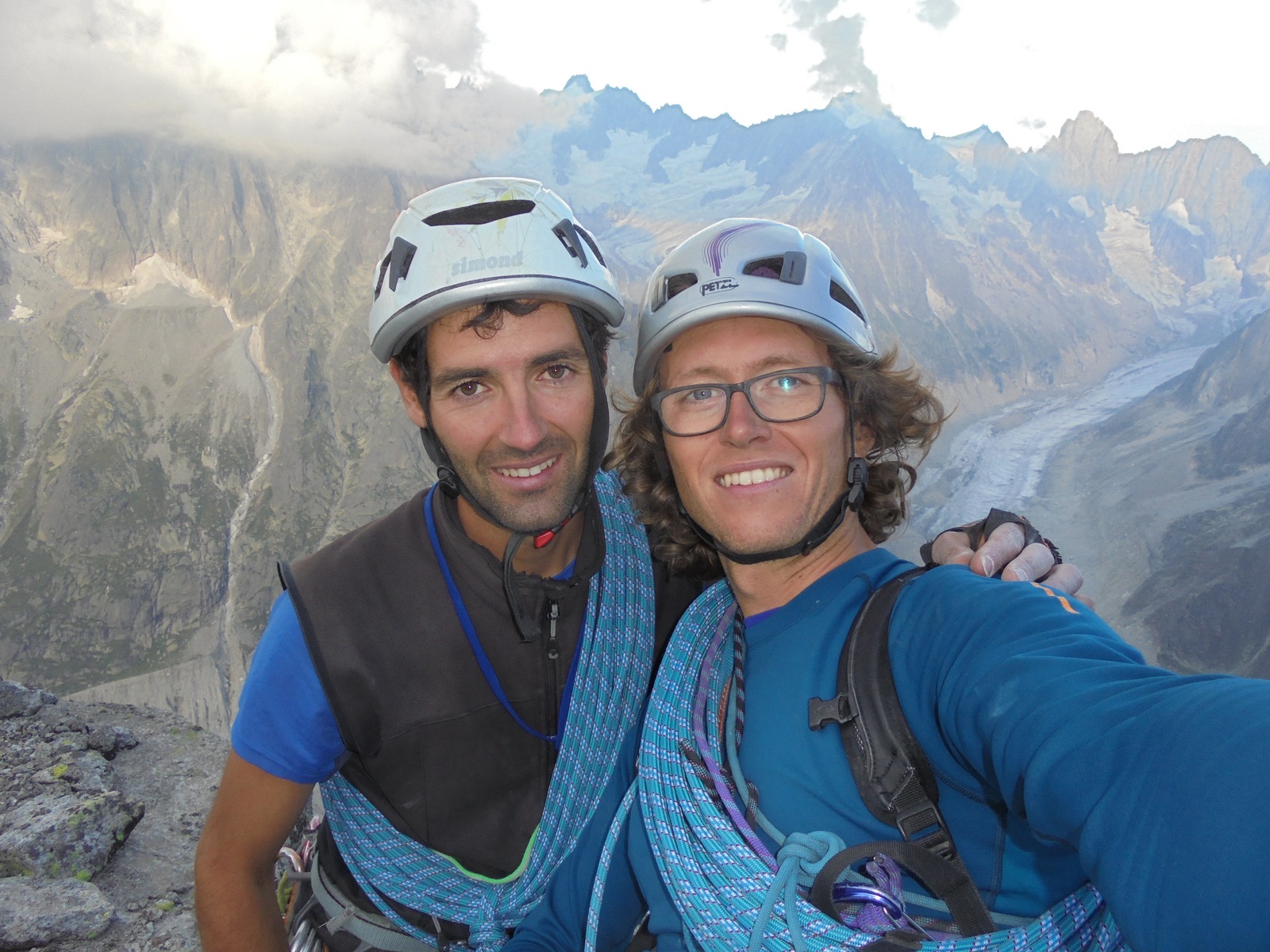
top of Mt. Blanc

top of Mt. Blanc

Dessert


Now we had reached the summit and descended to the valley, but my goal was to get back to Bolzano the same day, it wasn't really easy as we didn't want to spend much money and so we had to find someone who had the pass for the Mt. Blanc tunnel - not that easy, at least not on a Sunday with good weather, believe me. But in the end, not as soon as I hoped, we found someone and so Isra drove me to Val Veny where we had left my car and finally at five o'clock I started back home.
There are things that make you grow - this one certainly was of them!    

California Dreams - Pointe Trélaporte and República Bananera - Pointe de la République

Pointe de Trélaporte - California Dreams -11.08.2015


After having climbed the American Direct even though the weather was still good we had to rest a bit. That meant sleep and eat a lot. Then, (how else could it be?) it started to rain, but just for two days. Monday morning Thomas returned to Italy by bus and train. Fortunately I stayed in the same camping as Isra, a Spanish friend of mine.
We decided to climb two routes, the first on the Pointe de Trélaporte and the second on the Aiguille de la République. The advantage of climbing these two peaks was that they are really close to each other and that we knew a perfect bivouac place where we could spend the night and quickly get to the base of the routes. 
So on Tuesday we took the first train to Montenvers at  8 a.m., our backpacks filled with our climbing gear, sleeping bags and food. We didn't hurry up too much because we wanted to avoid to get to the base of the route already tired. After about two hours we got to the bivouac cave, where we left our stuff and ate something before walking up to the base of the route.

bivouac cave

 To get to the route you have to walk up a snow-ice slope that steepens up towards the end. In order not to have to carry to much weight we just wore hiking shoes and our crampons were not exactly designed for that kind of stuff, at least not mine. I had never tested those rubber crampons with some kind of of spikes underneath (yes...the ones you use in the city) before. I think the next time I'll take some better ones. They work until the snow surface doesn't get too soft. Fortunately we each had brought a walking pole and a light ice axe, so somehow we managed to get to the start of the route. 

very nice and clean 6b pitch in the lower part


the 7a pitch

7a pitch


6c+ slab at the end


This 12 pitches-route has been first ascended by Michel Piola in 2005 and follows a line of cracks and dihedrals to the top of the Pointe de Trélaporte.  The climbing is really good as in most Piola routes and offers pitches up to 7a. The slab pitches are quite well bolted while as the cracks are mostly clean. As we started quite late we got to the summit at about 19.00, after about 5 hours of climbing. From the summit we quickly rappelled down to the base. We didn't directly go to the bivouac as underneath the glacier we met two guys with whom we  started to talk a bit (they also were going to do the República bananera the next day). Perhaps it would have been better to go directly to our bivouac cave as afterwards, in the dark, we had some "route-finding" problems what means that we got there at about 11. At the bivouac we cooked some rice and finally went to sleep at about midnight.
We had to get up early because the route we planned to climb was quite long and the descend on the normal route takes some time. 


Aiguille de la République - República bananera - 12.08.2015


We got up at half past five and started around six o'clock. We passed by the bivouac where Jorge and Fabio had spent the night and at about seven we were at the base of the face. There were already two other guys at the start - or perhaps it would be better to say they tried to figure out where the start was. The problem is that there weren't any bolts in view and so it wasn't really evident where the route started. It was already quite late, almost half past seven, so we decided to skip the first pitches by going up the normal route and rejoin the Bananera underneath the old refuge. After a few pitches on snow and quite easy rock we left all the stuff we didn't need for the route at the first bolted rappel anchor. 

at the base

overneath the old refuge

We already heard the voices of Fabio and Jorge higher up and that reassured us that we were on the right route. The route, like most routes of that style doesn't always follow the easiest and most logical line, even though some pitches are very logical indeed because you follow straight cracks or dihedrals. All in all it is a superb route and the climbing is quite sustained as most pitches are 6a to 6c. The route finishes some pitches underneath the top of the Aiguille de la République where you join the normal route. The last pitch to get to the top is a short pitch with many bolts that can be aid-climbed, but it's worth to free-climb it as it isn't that hard (6c+) and offers very nice slab climbing. 


awesome - the 6b+ dihedral


one of the 6b+ pitches


the 6c+ pitch that leads to the top


summit


We topped out at about five o'clock.
We thought the descend would be a nightmare and would cost us a lot of time but actually it didn't find it is that complicated, at least compared to other descents in the Mt. Blanc range or the Dolomites. We descended quite fast, basically down climbing almost everything (we did 5 rappels). At about eight o'clock we were on the glacier again. It had been a long day and we were quite tired but I had to work the next day so we descended to the Montenvers train station. Isra decided to spend the night there and descend by train in the morning. I had to return down to Chamonix by foot, as I still had to prepare my stuff for the next day :-)

Dienstag, 18. August 2015


Petit Dru - Directe Americaine - 06.08.2015


the Petit Dru westface seen from our bivouac

Myths and history


The Petit Dru west face is definitely one of the most impressive faces around Chamonix.

Feared and loved amongst the climbers because of his beauty but also because the


difficulty of it's routes this poor face has gone through some hard times during the last 12


years. It was the hot summer in 2003 when a big part of the face collapsed followed by


another collapse in 2005. The consequence was that many important and classic routes


were partly or totally destroyed and from then on the face was declared as dead - or at


least almost. There is one route that survived the disaster even though the upper part is


now climbed on the north face: the Directe Americaine.


Don't go, It's too dangerous!


When you go and ask some local guides what they think about climbing the Dru, they


probably will tell you that it isn't recommendable at all. Even though the route is described


amongst the best 100 climbs in the Mont Blanc range in the Batoux guidebook it seems


that only very few climbers finally attempt to climb this face.


Is it really that dangerous? ..who knows. What is certain is that a part of the face still could


collapse and that it is more likely to happen after or during big heat waves.


But it is also certain that there are many other faces where the risk to get hit and killed by


rocks is way higher. The difference is that on this face the falling rock could be a big


bigger.


Anyway Isra, a spanish friend had told me that he had climbed the route some weeks ago


and that to him it seemed that the conditions were good.


Some snow had fallen since he had done it so we decided to wait for the upper part of the


wall to dry up a bit and wait for stable weather conditions. Fortunately we didn't have to


wait for long.


Battle plan


The original Directe Americaine doesn't lead to the top of the Petit Dru and so many

people just climb to the big jammed block and the rappel down the face. We wanted to

climb the whole face as it is described in the Bateaux guidebook and then descend

towards the Charpoua glacier. There are many ways you can climb this route, but it is very

likely that you have to bivouac at least one night. You can climb the first part of the route to

the jammed block on the first day and then climb the upper part and do the descend on the

second day. According to the informations we got we thought if should be possible to do

the climb and the descend in one push. Surely that meant we would have to use another

tactic, we had to climb "light and fast".

Approach


On Wednesday we took the train to Montenvers and under the weight of our backpacks

and the heat of the sun we climbed down the ladders to the Mer the Glace and then up

again on the opposite side towards the Charpoua hut. After the steepest part we took the

small path to the left that leads towards the Dru. We found some nice flat boulders not too

far away from the crossing, where we decided to spend the night. We didn't want to have

to walk too far to get our sleeping bags the next day, otherwise it would have been better

to spend the night in the bivouac-caves directly underneath the Dru.

We went up to the base of the face to see where the route starts and to leave our gear

there.


the flat boulders


The long way to the top


The night had been warm and so it was unusually easy to get out of our sleeping bags and

get ready to start. We went up the moraine and at about five we were already at the place

were we had left our gear the day before. As we didn't want to haul our bags up except for

the two hard pitches after the jammed block, so we packed the crampons, ice axes, water

and food in one backpack and filled the other one with our clothes. So the lead-climber

could take the lighter backpack while the follower could climb with the heavy one.

In the lights of our headlamps we traversed the steep snowfield to the start of the ramp

that leads to the first pitches. We started to climb at about 5.30 and we tried to do the first

pitches as fast as possible as we knew that the lower part is more exposed to stone-fall. 


I felt quite relieved as we got through this first pitches. Fortunately we didn't have any route-

finding problems as the first pitches had been bolted some years ago by a probably

somehow disturbed French climber from the Chamonix valley.

The interesting thing of our tactic was, that you somehow felt relieved when you could lead

a pitch, because climbing with the "pig" on your back wasn't really relaxing.

Anyway, after about 7 pitches we got to the first ledge. From there on the wall steepens up

and the line to follow seemed quite obvious to us, so we just continued towards a big

dihedral....unfortunately the wrong one...so we abseiled down again to the sledge and had

a better look at the topo :-).


up and then to the left


After this two-pitches intermezzo and two more pitches we got to the right dihedral, a nice

40 meters 6b with many rock pitons. We had two route descriptions: one was the topo of

the topoguide book and he other one was the Batoux-topo. There are quite big differences

regarding the grades of the pitches. In our opinion the second and third 6b (according to

the Bateaux guidebook) are easier but i.e. surely the last pitch to get to the jammed block

is way harder than 4c...


the 40 meters dihedral


almost at the jammed block


We got to the jammed block at about half past twelve. We stopped there to eat and drink

something before we started to climb the first easier pitch of the "90 meters dihedral".

The two 6c pitches of the dihedral are definitely the crux pitches, but they are quite well

protected. We decided to haul the "pig" so that at least the leader could climb without

additional weight. I already felt quite tired after having climbed the lower pitches with

backpack, but still fit enough to get rid of these two pitches.


the first easier pitch of the 90m dihedral

the first 6c pitch of the 90 m dihedral


the two crux pitches of the 90m dihedral are quite well protected

the second 6c pitch of the 90m dihedral


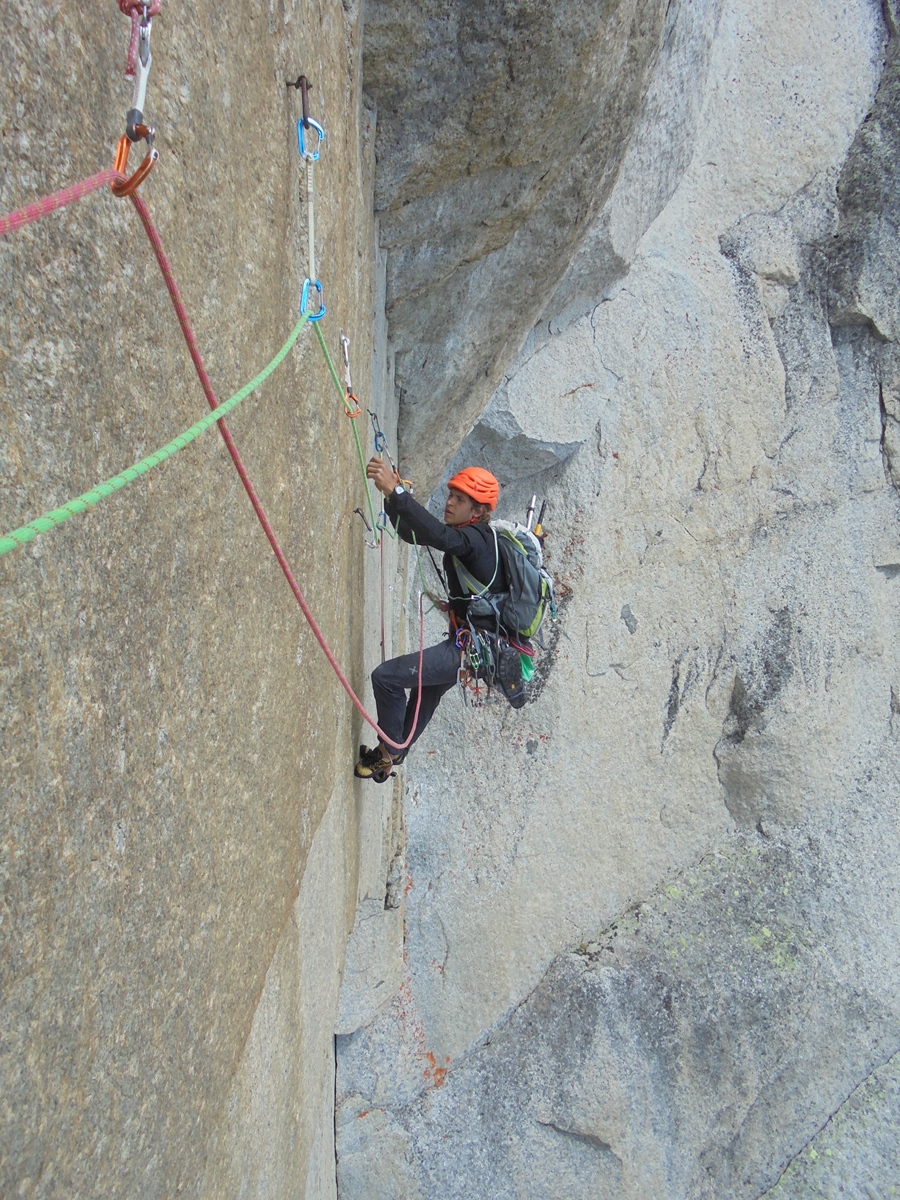
To join the Allain-Leininger route, which is the route you follow to get to the top, you have

to do an aid climbing traverse (German rescue traverse).

I just say: interesting. If you are used to do hard aid climbs and hang on sky hooks and

copperheads you probably don't feel scared at all of hanging yourself on 60 years old rusty

and twisted bolts. Anyway, for us it felt interesting.


aid-climbig in the german rescue traverse

climbing up the first part of the traverse-pitch

rusty bolts


Past the traverse we thought it would be quite easy and fast to climb the last 9 pitches to

the top. We were wrong... The 4c and 5a pitches turned out to be a little bit harder, I would

say up to 6b. If you look at the Batoux-topo you could think that you follow a quite straight

and evident line, but it isn't that easy at all. So my advice is that if you plan to climb this

route you better search for a better description on internet.

In the meantime the upper part of the mountain was hidden in the clouds and so route-

finding got even more complicated. Time kept on passing by and we didn't really

understand where we were so we just tried to keep on going searching for easiest way to

the top.


easy first pitch after the traverse

fog-climbing


At about nine o'clock we stood on a platform, about twenty meters underneath the top. It

had taken us approximately 5-6 hours to get there from the end of the traverse and instead

of nine pitches we had climbed about 12...


on the plattform underneath the summit of the Petit Dru


It was getting dark and we basically had climbed the whole upper part in the fog, so we

decided to bivouac instead of going on and risk not to get stuck during the descent.

We used the ropes as sleeping mats and and then slipped into the two persons bivouac

bag. I think it would have been fine if the wind wouldn't have increased and it wouldn't

have started to rain a bit... We passed a intense night shivering, shaking an clapping our

hands, rubbing our legs and sleeping a little bit.

Yeah that's real alpinism, or should I say masochism?? :-)


good morning Mont Blanc


The descent


At about 7 o'clock we started again, this time a bit more tired and with less ease than the

day before. First we got to the top of the Petit Dru, where we enjoyed the sun for a few

minutes, then we traversed to the Brèche des Drus and climbed to the top of the Grand

Dru
. We were happy that we had decided to bivouac underneath the summit of the Petit

Dru
because it wouldn't have been easy at all to climb to the top of the Grand Dru in the

dark and even harder to find the rappels down to the Glacier de Charpoua.


summit


Brèche des Drus


The description of the descent we got in the Office de Haute Montagne was very good and

so we quite easily found the bolts from where you do the first rappel. The face you rappel

down is not always vertical and with many ledges. In the lower part you even rappel down

along a rock couloir. The ancors are not always easy to find so I wouldn't recommend

anyone to do the descend from the Grand Dru at night.

After about nine or ten rappels we were on the Charpoua glacier where we quickly

descended go the Charpoua hut. We didn't stop at the hut but kept on descending until we

got to the next stream where we finally could rehydrate, as we hadn't drunk that much the

last day..


The descend seen from the Charpoua glacier


After getting our sleeping bags we descended to the Mer the Glace and got back to the

Montenvers station at about five o'clock.


All in all it was a really good climb, one of the best I have done in Chamonix and if it wasn't

for the objective dangers I would say a "must do"!

One route less on my wishlist :-)